Login: pantheon credentials (yasin). UI served at syntrad.pro:8445 → 127.0.0.1:9119. Full web dashboard: sessions, chat, config, cron routines, Bot Mode profiles. The CLI fleet (scalp / research / XAUUSD review) runs on the same v0.20.4 install. Distinct from the HERMES tab (XAUUSD demo lab).
✦ ODYSSEUS AI WORKSPACEauthenticated self-hosted workspace · chat, agents, research, memory, documents, tasks and integrations
Odysseus is isolated behind its own sign-in and runs on 161. The embedded workspace supports its bundled chat, agents, research, vector memory, documents, notes, tasks, calendar and model-provider workflows. Configure provider, email and OAuth credentials inside Odysseus; no credentials are stored in this dashboard.
SYNTRAD / MERQUAN PROPRIETARY RESEARCH
QUANT FORGE
MERQUAN's private research factory for designing, testing and promoting original quantitative engines built exclusively from MERQUAN data, specifications and intellectual property.
3SPECIALIST MARKET STACKS100%MERQUAN DATA CONTRACTS100%PROPRIETARY ENGINE DESIGN0LIVE EXECUTION PATHSMERQ-EQUITY
EQUITIES
Original cross-sectional engines for direction, relative strength, liquidity, volatility, dispersion and regime behaviour.
MERQUAN EQUITY STACKMERQ-ETF
ETFs
Original rotation, leadership, flow, correlation and risk-on/risk-off engines across certified ETF universes.
MERQUAN ETF STACKMERQ-INDEX
INDICES
Original breadth, participation, volatility, correlation, regime and tail-risk engines for global index markets.
MERQUAN INDEX STACKATALLUM GOVERNANCE
GATED
Every engine receives immutable data lineage, walk-forward evidence, cost tests, calibrated uncertainty and signed promotion receipts.
MERQUAN CONTROL PLANEMERQUAN KNOWLEDGE CORPUS
SKILLS + PDF
The complete internal quant-skill library, research PDFs, technical records and experiment evidence form the controlled design corpus for every engine.
PRIVATE KNOWLEDGE LAYERGPU BATTLE LAB
RTX 6000 PRO
Every candidate is stress-tested on MERQUAN data across walk-forward windows, regimes, costs, perturbations, Monte Carlo paths and portfolio interactions.
HARDWARE VALIDATION LANE
VALIDATION LANE
1 / SPECIFYDefine an original hypothesis, market, horizon and falsifiable acceptance criteria.2 / BUILDUse the complete MERQUAN quant-skill and PDF corpus against certified point-in-time data.3 / BATTLE TESTRun RTX 6000 Pro leakage, stability, turnover, cost, regime, Monte Carlo and adversarial tests.4 / SHADOWEvaluate signed engines on immutable out-of-sample market snapshots.5 / PROMOTEATALLUM admits only reproducible engines with complete evidence receipts.
PROPRIETARY FIREWALL: no external code, copied formulas, imported signal libraries or third-party model weights. Every promoted quant must be independently specified, implemented, tested and owned by MERQUAN.
SYNTRAD / MERQUAN REFERENCE
DATA STORAGE REFERENCE
Where MERQUAN’s current research corpus, QTS snapshots, live DTN market files, and Syntrad interface are stored. Use this page as a map of the real storage locations and their intended jobs.
TERNFS STATUS: ARCHITECTURAL REFERENCE ONLY — NOT DEPLOYED IN MERQUAN TODAY.
RESEARCH CORPUS / WORKSTATION
Searchable paper corpus: SQLite index, readable source exports, and a verified provenance manifest.
The deployed Syntrad single-page terminal and this reference tab.
161:/var/www/syntrad/index.html
TERNFS / FUTURE FILE SYSTEM
TernFS is XTX Markets’ distributed filesystem design. When deployed, file contents are split into immutable blocks across storage services; a registry stores the metadata that says which blocks form each file. It is not one folder on one server.
Status today: not deployed — no TernFS files stored in MERQUAN. TernFS source checkout (remote only): 161:/opt/merquan/qts-factory/vendor/ternfs/ Pinned source commit: 855fcfb7a812f2ce0648f06ed56dec8f8ba839f4 TernFS status: source is available for inspection; the distributed filesystem is not deployed. Current MERQUAN files: storage locations listed above.
TERNFS TECHNICAL BRIEF
Why the implementation is split between C++ and Go, how it is built, and where it fits—and does not fit—in MERQUAN.
C++ SIDE / METADATA & CONSENSUS
ternregistry — one logical instance; deployment topology and storage statistics; RocksDB persistence with five-node consensus via LogsDB.
ternshard — 256 logical instances; filesystem metadata including attributes, directory listings, file-to-block maps, and block-service-to-file maps; UDP bincode request/response.
terncdc — Cross-Directory Coordinator; serialized transactions for create, remove, and move operations that span directories.
GO SIDE / DATA PATH & OPERATIONS
ternblocks — block service; one logical instance per disk. It streams blobs from disk to TCP and may move to C++ if performance later requires it.
ternweb — stateless UI and JSON API; terncli — migrate and defrag; terngc — GC, scrubber, and migrator daemons.
ternfuse, terns3, and the xtx/ternfs/client Go library provide client and integration paths.
FASTEST CLIENT PATH
ternfs.ko is the C Linux kernel module: the fastest client path. It is Linux-only.
FUSE remains available as a Go client path where a kernel module is not appropriate.
ci.py runs integration tests. ternrun starts a full local instance: 256 shards, CDC, registry, block services, web, GC, and a FUSE mount.
HONEST PLATFORM CONSTRAINTS
TernFS is Linux-native. Docker Desktop or WSL2 can build the containerised Go/C++ services; the kernel module and its qemu tests are Linux-only.
Under MERQUAN’s current remote-only policy, we do not use a Windows workstation for this source. The remote checkout on 161 can be read, built, modified, and extended in a Linux container.
MERQUAN RELEVANCE & LIMITS
This matches a smaller-scale version of XTX’s stated use case: cold raw market data flowing into short-lived random-access datasets between GPU jobs.
Immutable/write-once files: good for raw tick archives and versioned research snapshots.
Not for tiny files: the project expects median files around 2 MB; per-symbol small mutable updates do not fit.
Permissionless: authentication is deferred to a gateway. The production S3 gateway is not open-sourced; terns3 is a minimal starting point.
THE DECISION IN ONE LINE
TernFS is a data-lake substrate for large immutable datasets—not a mutable store, not an order-routing system, and not a replacement for a live market database.
Research: search papers and trace claims back to a source file.
Market identity: resolve a logical market to its certified cash, futures, or options provider symbol.
Data lineage: see where a model input came from, when it was captured, and what hash proves its version.
QTS gating: build read-only eligibility snapshots before any shadow-only model work.
Future storage design: use TernFS ideas—immutable files, registry metadata, integrity checks, and replication—when MERQUAN is ready to deploy a distributed data fabric.
NAWA GENOME / QUANTUM RESEARCH FACTORY / 161
ORIGIN QUANTUM
QPanda3 + algorithm library + Wukong QCloud jobs are live for MERQ-QTS shadow research. Origin PilotOS (本源司南) — their full quantum OS — is staged but not yet installed (login-gated download + disk).
RUNTIME INSTALLED & OFFLINE-VERIFIED · NO QUANTUM WORKER RUNNING
01 / PINNED SOURCE
pyqpanda-algorithm
Official Apache-2.0 Origin Quantum source. Pinned for reproducible research at commit 5d7af4cab02763626b22ffa98a033dc796bd3f49.
Python 3.12 virtual environment, pyqpanda3 0.4.0, and pyqpanda_alg 2.0.0 are installed. QAOA/QSVR simulator smoke checks passed. There is no systemd unit or continuous worker.
Origin’s PilotOS / Origin Pilot (Community Edition) is the real quantum operating system: Docker image + AutoDeploy, MySQL/Mongo, UI on :10020. It is not the same as pyqpanda3. Download is login-gated on OriginQ Cloud; 161 currently lacks free disk for the image (docs: hundreds of GB / ~1 TB). Staging ready at the path below — drop pilotos-*.tar.gz here after download + license.
Also QSVM, QSVR, QPCA, QSVD, Grover, QKMeans, QMRMR, and QARM. The right use is benchmarked hybrid research, never assumed quantum advantage.
04 / QTS INPUT
Immutable evidence snapshots
The worker consumes versioned 161 QTS snapshots only, with symbol identity, data hashes, and as-of timestamps. It does not read or alter live feeds directly.
161:/opt/merquan/qts-factory/artifacts/
05 / FIRST USE CASE
Constrained portfolio & feature research
Compare classical baselines against QUBO/QAOA allocation and QMRMR feature-selection experiments on a small certified pilot cohort.
06 / HARD BOUNDARY
No execution path
Quantum outputs are labelled experimental, receipt-hashed, and shadow-only. They cannot route orders, change production weights, or promote models.
07 / WUKONG-2 API PILOT
Hardware path proven
The bounded NAWA eight-engine QUBO completed on Origin Wukong 180-2. Tuned p=1 reduced hardware average QUBO energy from 0.842 to 0.042, but did not beat the classical exact optimum; it remains research evidence, not a model change.
A 5,000-bar DTN/IQFeed archive window was receipt-hashed from 139 to 161. Training selected NAWA e1 + e2 + e6; Wukong-2 preserved the exact three-engine constraint 61.7% of the time and sampled that classical optimum 4.38% of the time, close to the 4.51% ideal expectation. The five-window test is exploratory only.
The first read-only XAUUSD hourly NAWA dashboard receipt has landed on 161 with the raw E1–E8 score vector, E9–E13 additions, confluence details and SHA-256. It is an input record only—not a trade, performance result, or quantum recommendation. Further captures remain manual until post-horizon shadow evaluation is defined.
A Finnhub-sourced 2006–2026 XAUUSD research window produced a six-engine selection QUBO. Wukong-2 preserved the three-engine constraint 65.9% of the time, but sampled the classical best trio 0.39% of the time versus 3.42% in ideal simulation. That is not a model improvement. The result stays in the evidence trail and the next gate is outcome-labelled live-dashboard shadow data.
3 / ORIGIN QUANTUMRun simulator and hardware-ready experiments.
→
4 / SHADOW REVIEWCompare against classical baselines; no execution.
MERQUAN / DOCUMENT INTELLIGENCE
PDF LIBRARY OCR
Register the locations of PDF libraries you want the future OCR pipeline to process. The queue supports remote 139, remote 161, and Local locations without reading or uploading a single file.
STAGING ONLY · NO PDF UPLOAD · NO SCAN · NO FILE MOVE · NO BAIDU REQUEST YET
01 / ADD A SOURCE LOCATION
Tell the OCR factory where the library is
Add a folder or a single PDF path. This is a planning register stored only in this browser, so it does not give the website permission to touch the path.
02 / STAGED SOURCES · 0
PDF source register
This list is the hand-off manifest for the future OCR deployment. Copy it when you want to give the implementation exact locations.
1 / REGISTERTell Syntrad where the PDFs live. Current stage.2 / PREFLIGHTRemote-only access check, PDF inventory, hashes, and page count.3 / OCR + STRUCTUREExtract reading order, tables, formulas, headings, and source-page evidence.4 / SEARCHABLE CORPUSProduce immutable structured outputs and a searchable library index.
SYNTRAD.PRO / FINANCIAL FOUNDATION MODEL LAB / RESEARCH-ONLY
KRONOS
Domain-specific market modelling for financial candles. The public Kronos suite is installed locally: hierarchical OHLCV tokenisation, autoregressive forecasting, and a controlled bridge to SYNTRAD’s existing XAU_USD H1 practice feed. Outputs remain isolated from order routing.
SERVICE CHECKINGEXECUTION DISABLEDRESEARCH OUTPUT — NOT INVESTMENT ADVICE
XAU_USD H1 FORECAST CONTROL
Validating the local model suite…
LAST CLOSE
—
TERMINAL FORECAST
—
HORIZON CHANGE
—
FORECAST TRAJECTORY
SELECT A MODEL AND RUN A CONTROLLED H1 RESEARCH FORECAST
TIMESFM 2.5 FORECAST
GOOGLE DEEPMIND FOUNDATION MODEL · 200M PARAMETERS · PRE-TRAINED ON 100B TIME POINTS · ZERO-SHOT
Agent idle. Press START RESEARCH to begin.
DeepSeek R1 will analyse experiment history and generate
intelligent hypotheses for each parameter change.
Real XAUUSD 1H candles from OANDA.
HAR-RV + GARCH backtest. Annualised Sharpe as objective.
📈 SHARPE RATIO — EXPERIMENT HISTORY
📄 AGENT LOG
MERQUAN AUTORESEARCH — Inspired by Karpathy
Real XAUUSD candles · DeepSeek R1 hypotheses · OANDA data
HAR-RV + GARCH signal · Annualised Sharpe objective
Best config persists across sessions automatically
📋 EXPERIMENT RESULTS
#
PARAM
CHANGE
SHARPE
DELTA
DECISION
No experiments yet
⚙ CURRENT BEST CONFIG WINNING PARAMETERS — AUTO-SAVED
No experiments run yet
HOW IT WORKS
▶ Pulls 500 real XAUUSD 1H candles from OANDA
▶ DeepSeek R1 reads experiment history and reasons about next hypothesis
▶ Applies parameter change to HAR-RV + GARCH signal engine
▶ Runs full backtest — computes annualised Sharpe ratio
▶ Keeps improvement, reverts failure
▶ Best config auto-saved to server — reloads next session
SYNTRAD.PRO · XAUUSD DEMO LAB · NOUS RESEARCH HERMES
HERMES · QUICKSILVER
Hermes v0.19.1 brings the Quicksilver runtime into SYNTRAD's isolated XAU_USD demo lab. Reviews now run on the current Nous model route with project rules loaded, while manual approval, market guards, and one-variable experiment rails remain enforced.
INGESTRead SYNTRAD signals, OANDA practice state, reports, logs, and current strategy YAML.
REVIEWScore the latest outcome against Sharpe, drawdown, profit factor, and execution quality.
HYPOTHESISFind one reason the strategy moved toward or away from the stated goal.
EXPERIMENTPropose exactly one controlled variable change for the next cycle.
MEMORYSave the lesson so future reviews start from what was learned.
THE SELF-IMPROVING TRADING ELEMENT
LEARNXAUUSD MEMORY
OBSERVEprice, spread, signal, regime
SCORESharpe, PF, DD, execution
EXPLAINwhy outcome moved
CHANGE 1one parameter only
RETESTdemo account cycle
REMEMBERnew baseline if better
GOAL FUNCTIONImprove XAU_USD demo performance toward Sharpe ≥ 1.0, profit factor ≥ 1.20, max daily drawdown ≤ 2%, max total drawdown ≤ 6%.
CURRENT HYPOTHESISTrade frequency is being suppressed by the BJ proximity gate. First controlled test: reduce threshold from 2.5x ATR to 1.0x ATR, without changing risk sizing or entry logic.
PARAMETERS UNDER WATCHBJ proximity, Hurst regime, CumDelta Z-score, spread, stop distance, proposal score, macro blackout, and execution quality rating.
WHAT MAKES IT DIFFERENTHermes does not just generate a signal. It records the result, judges whether the result moved toward the goal, forms a new hypothesis, and proposes the next one-variable test.
RISK RAILS
Max XAU units1
Max open trades1
Max trades/day6
Max loss/trade0.25%
Stop lossREQUIRED
Mode promotionMANUAL
MODEL ROUTING
DAILY REVIEW
Nous Portal · tencent/hy3:free
HEAVY WEEKLY REVIEW
Nous Portal · tencent/hy3:free
FAST CHECK-IN
Nous Portal · tencent/hy3:free
SETUP CHECKLIST
1
Quicksilver runtime active Hermes v0.19.1 runs under the isolated `merqbot` service account from a verified release tag and locked dependency set.
2
SYNTRAD lab created `/srv/merqbot/syntrad-engine/hermes_xauusd_demo` holds the agent rules, reports, state, and strategy YAML.
3
Demo boundary enforced OANDA practice credentials remain isolated in the service environment; every cycle checks market access and XAU_USD tradeability before AI review.
HERMES PARAMETER CONSOLE — STAGED CONTROLS
BJ PROXIMITY GATE1.0x ATR
Lower means more XAUUSD entries pass structure filter; higher means fewer but stricter trades.
MAX TRADES PER DAY6
MAX XAU UNITS1
STAGED EXPERIMENT CARD
Loading staged settings...
These controls are visual/staged right now. They do not write strategy YAML or place trades. When you want live demo control, I will wire this through an authenticated API with audit logs.
NEXT ACTIONS
WATCH CUTOVERConfirm each 30-minute Quicksilver review completes under the existing market and risk guards.
VERIFY ROUTETrack the current Nous Portal model, report quality, latency, and any provider fallback event.
REVIEW QUALITYPromote no experiment unless the evidence, one-variable rule, and manual approval gate all pass.
LATEST HERMES REPORT
Loading report...
Loading Hermes status...
MERQUAN PANTHEON
6 PERSONAS — ROUTED VIA NOVITA / DEEPSEEK / NIM
MOCK MODEWS CONNECTINGMODEL ROUTER CLEAN
PERSONA ROSTER
LIVE EVENT STREAM
0 EVENTS
TOKEN BURN — LAST HOUR
0
TOTAL TOKENS
DREAM TIMELINE — 04:00 UTC
NEXT IN —
No dreams yet. First fires at 04:00 UTC after Mercury wires in.
PROVIDER HEALTH
MODEL ROUTING — LAST 50
VAULT — /root/merquan_pantheon/vault/
loading…
DISPATCH
SYNTRAD LABS / ISOLATED SANDBOX
MIROFISH
Standalone MiroFish research sandbox for simulation and post-trade analysis only. No direct Hermes dispatch and no live order routing.
LOADING
Sandbox Status
State
Loading status manifest...
Launch Readiness
This tab is intentionally isolated from live trading. To run MiroFish you must provide the LLM and Zep keys in the sandbox env. Keep this lab separate from Hermes execution.
cd /var/www/syntrad/labs/MiroFish
cp .env.example .env
# fill LLM_API_KEY, LLM_BASE_URL, LLM_MODEL_NAME, ZEP_API_KEY
npm run setup:all
npm run dev
Integration Policy
Loading policy...
MERQUAN Use Case
Loading use case...
SYNTRAD / MERQUAN UNIVERSE
DECISION FUSION
Fusion layer for model consensus, market context weighting, and execution-grade directional confidence. This tab is now live and ready for wiring to full optimizer routes.
LIVE
Current Surface
Status
Active on syntrad.pro
Source
/var/www/syntrad/index.html
Server
161.35.43.80 (merqintel-agent)
Next Hook
OriginQ optimizer + MiroFish sandbox + signal pipes
TAB LIVEPHASE 1WIRING IN PROGRESS
Fusion Outputs (Planned)
1) Regime state and confidence score 2) Directional bias and veto rules 3) Entry-quality score with risk regime tags 4) Execution policy handoff (scalp/intraday).
SYNTRAD RESEARCH LAB / FINANCIAL REASONING
FIN R1
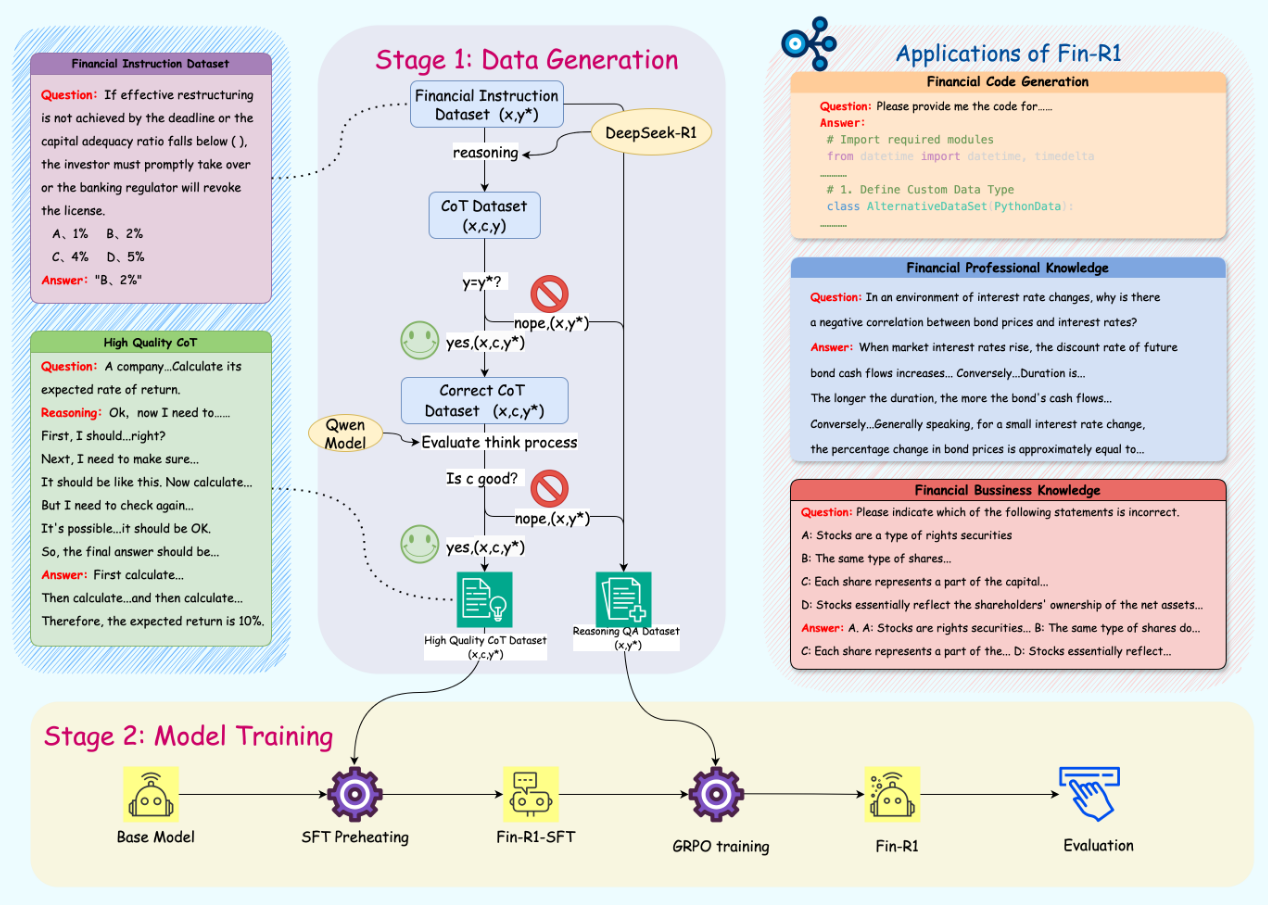
Fin-R1 is a 7B financial reasoning model built on Qwen2.5-7B-Instruct with SFT and GRPO reinforcement learning for financial code, calculations, compliance, risk control, ESG, and multi-step finance QA.
The GitHub repository and model weights are now local on 161. Serve with vLLM using served model name Fin-R1.
MERQUAN QFUSION Workbench
Objective: build one vLLM-loadable financial reasoning model for SYNTRAD: MERQUAN FINR1 QFUSION.
Fin-R1 remains the base because it is already Qwen2.5-7B-Instruct plus finance SFT and GRPO reasoning training.
We do not pull it backward with a blind Qwen weight blend.
Final Model Target
/opt/merquan/models/MERQUAN_FINR1_QFUSION
Base
/opt/merquan/models/Fin-R1
Qwen Role
Teacher / judge / reference model only, not default 50-50 weight merge.
Training Lab
/opt/merquan/finr1_loop_lab
SFT Seed
60,000 audited examples at /opt/merquan/finr1_loop_lab/data/merquan_finr1_sft_seed.jsonl
DPO Seed
10,000 preference pairs at /opt/merquan/finr1_loop_lab/data/merquan_finr1_dpo_seed.jsonl
Loop learning: attempt -> verify -> score -> classify failure -> create SFT/DPO/RL record -> train MERQUAN adapter -> holdout evaluation -> promote only if better.
Deterministic finance rewards come first: numerical tolerance, no-arbitrage checks, schema validity, cashflow equality, Greeks/PDE consistency, portfolio accounting, risk constraints, and compliance structure.
ONE vLLM MODELFIN-R1 BASE PRESERVEDMERQUAN LORA ADAPTERSFT -> DPO -> RLPROMOTION GATENO BENCHMARK LEAKAGE
Integrity rule: no QFBench tests, reference solutions, expected outputs, oracle artifacts, or benchmark-specific leaked answer files are allowed in training data.
The deployable model is produced by merging the trained MERQUAN adapter into Fin-R1 after evaluation, then serving that single folder through vLLM.
9,543 train + 2,388 validation sentiment records. Convert into finance sentiment instruction/eval tasks.
S3 Backups Prefix
s3://merqintel-data/backups/ - 63.421 GiB total
MERQUAN Corpus Tar
MERQUAN-CORPUS-20260426-BACKUP.tar contains merquan-corpus PDFs, source tarballs, and abstracts. Use for CPT/RAG after extraction and cleaning, not raw SFT.
Use policy: JSONL instruction data can feed SFT after dedupe and leakage checks. Corpus archives must be extracted into clean text chunks first. Raw backups, app code, verifier artifacts, or benchmark answer files are not training data.
Prompt Console
Endpoint runner is ready. If the Fin-R1 vLLM service is not running yet, use BUILD PAYLOAD or COPY VLLM LAUNCH.
Benchmark Positioning
Model
Params
FinQA
ConvFinQA
Average
DeepSeek-R1
671B
71.0
82.0
78.2
Fin-R1
7B
76.0
85.0
75.2
Qwen-2.5-32B-Instruct
32B
72.0
78.0
73.8
Fin-R1-SFT
7B
73.0
81.0
71.9
Use this tab as the SYNTRAD control surface for local research, prompt payloads, and eventual vLLM inference once weights are deployed.
Sanctum Control Surface ? Live System Schematic
MANAGEMENT
Complete clickable map of modules, responsibilities, links, dependencies, and execution readiness. Built for operational clarity and investor-grade walkthroughs.
Modules
0
Links
0
Dependencies
0
Critical Paths
0
Select a module to inspect full details.
Live Dependency Schematic
Execution Notes
MANAGEMENT view tracks what each component does, where it runs, and which systems it can block or enable. Use this for fast handovers and investor walkthroughs.
Atlas Intelligence Layer
CODE MEMORY
Repository memory, graph topology, semantic lookup, change impact, logs, and guarded engine controls for Syntrad and Atlas on server 161.
Runtime
Loading
Proxy
/api/code-memory
Projects
0
Graph Health
Loading
PROJECT REGISTRY
GRAPH TOPOLOGY
servicerepoindexrisk
ENGINE CONTROLS
Code Memory tab initialized.
Microsoft Research · Merquan Agent Improvement Layer
MS SkillOpt
SkillOpt-Sleep turns local agent experience into validation-gated skill proposals. The engine runs on Yasin's PC, where the transcripts live. MerqIntel server 161 hosts this reference and status surface only; it never receives raw transcripts or provider credentials.
Engine
Installed
Registered paths
1,670
Unique skills
1,007
Validation gate
ON
Adoption
Manual only
LOCAL AGENT INTEGRATIONS
CODEX
Installed
Native Microsoft skill installed. Reads local Codex archives; stages one exact target skill at a time.
CURSOR
Installed
Local Cursor plugin and command installed. Transcript source registered; restart Cursor to surface the plugin.
KIMI
Installed
Kimi CLI v0.27.0 authenticated through managed:kimi-code with kimi-code/kimi-for-coding; Merquan SkillOpt bridge registered.
HERMES
Installed
Hermes v0.19 bridge installed. User and application-managed skill roots are registered; live replay requires reviewed tasks, and the native curator remains independent.
A reusable specification workspace for every MERQUAN project. Each project has isolated answers and one immutable whiteboard shared by ARCHITECT, CHIEF CODER, and CODE CHECKING.
QM is a multiplayer agent harness for work — in Slack and on the web. Built for startups:
every employee gets an isolated workspace with scoped memory, files, keychain, permissions, crons and a durable
sandbox, while channels, group messages and projects allow collaboration with the same agent. Harness-agnostic
by design: Pi, OpenCode, Codex and Claude Code all drive the same headless core, so a deployment is never tied
to a single vendor.
Each person and each room owns scoped memory, files, keychain view, permissions, crons, web apps and a durable sandbox. Personal customisation coexists with collaborative channel work.
Slack + Web, One Identity
The same identity and configuration carries between Slack and the web app. Admin panel and public portal are optional plugins over the core HTTP API.
Multi-Harness Core
Pi, OpenCode, Codex and Claude Code drive one headless core — switch harness or model without re-platforming. Postgres holds sessions, memory and the queue.
Shared Skills & Skill Packs
Skills are scope-owned and shareable by grant, with admin-gated promotion to the whole org and skill packs imported from git repositories — directly relevant to the Merquan SkillOpt layer.
Background Work
Crons and watches run while nobody is looking: inbox triage in a learned voice, project channel updates, CI monitoring, report generation.
Durable Sandbox
A small fixed tool surface; the execute tool runs commands in the scope's own isolated sandbox — its durable computer, where installed tools stay installed.
Repository cloned read-only to MerqIntel 161 at /root/yc-qm for evaluation against the Merquan agent stack
(Codex · Cursor · Kimi · Hermes · SkillOpt). Not deployed; no credentials, tokens or transcripts are attached to this clone.
Update with: cd /root/yc-qm && git pull
OMNIROUTE
PRIVATE AI ROUTER · SERVER-SIDE ON SYNTRAD.PRO · CHAT · UPLOAD · DOWNLOAD
CHECKINGLOCAL SAFE
ROUTER STATUS
serviceloading...
SESSION
USE THIS AI
Qwen routes listed. Refresh confirms live upstream status (Pantheon htpasswd).
UPLOAD
No files staged.
Keys stay server-side in /etc/merquan/omniroute.env. API uses the same Pantheon basic-auth user as the Pantheon tab.
INTERACTIVE CHAT
SYSTEM
OmniRoute ready. Pick a Qwen model above, then chat. First API call may prompt for Pantheon username/password.
SYNTRAD / EXTERNAL REPO INTELLIGENCE
TRADER
Seven public GitHub projects that extend an LLM into a data, research, decision and execution stack for trading. Source: “7 Free GitHub Repos That Turn Claude Into a $500K Quant Trader” (video transcript, Sep 2026) — but every metric below was re-pulled from the GitHub API on 2026-09-21, not taken from the video.
VERIFIED 2026-09-21 via api.github.com · the video's figures were accurate where it gave them · it omitted that TradingAgents is the largest of the seven by a wide margin, and that the Alpaca server is an official first-party project
STANDING POLICY — NOTHING ON THE WORKSTATION. No repository here is installed, downloaded or run on the Windows PC, without exception. Anything admitted runs on a remote box. TradingView Desktop and its MCP are live on the merqplan droplet (167.172.61.98) as of 2026-09-21 — headless, browser-accessed at /tv/, never local.
Official description: “Open Data Platform for analysts, quants and AI agents.” Aggregates equities, crypto, options, macro and economic series from dozens of providers behind one interface, exposed to a model as an MCP server. The source positions it as the free counterpart to a Bloomberg terminal. This is plumbing — it answers questions; it does not decide or execute.
Macro and economic series (Federal Reserve provider)
Multi-provider routing under one API
Charts and tables rendered from the model side
Topics declared by the repo: ai, crypto, derivatives, economics, equity, finance, fixed-income, machine-learning.
WORKED PROMPT FROM SOURCE
A cross-asset macro read assembled in one call:
Using OpenBB, pull 30 days of Bitcoin price action, the US 10y Treasury yield (Federal Reserve provider) and DXY (Yahoo Finance). Chart them and summarise what the macro picture says for crypto this week — rates, the dollar, and Bitcoin momentum.
RELEVANCE TO MERQUAN
Overlaps heavily with capability the estate already owns. DTN/IQFeed on 139 serves 21–67 years of daily history plus a live options book; QuestDB and the futures panel already back the MERQCAUSAL demo. OpenBB's value here is breadth of free providers for instruments the estate does not capture — equities above all, since the fleet inventory holds none — not replacement of the existing feed.
WORKSTATION INSTALL — FORBIDDENAs with everything on this page. If admitted, it runs as a remote MCP endpoint behind the existing gateway, never as a PC install.
The source claims a bridge that drives the TradingView desktop application to draw support/resistance and add indicators. No public repository matching that description exists. Of four surveyed TradingView MCPs, all take other routes: Playwright browser automation, scraper libraries, or unofficial API clients. The one deployed here fetches chart snapshots via Playwright against an authenticated session — and was then extended in-house to actually draw.
18STARS (VERIFIED)6MCP TOOLS AFTER EXTENSION3SHAPE NAMES THAT WORK0FILES ON THE WORKSTATION
DEPLOYMENT — 2026-09-21TradingView Desktop 3.4.1 and the MCP both run on the merqplan droplet. Xvfb supplies a 1920×1080 virtual display, openbox manages windows, x11vnc and noVNC deliver the screen into a browser over existing TLS at /tv/ behind basic auth. Both VNC ports verified closed to the internet. Authenticated as a dedicated free account so the Pro session stays on Yasin's own devices — TradingView caps concurrent sessions, and logging in remotely evicts the others.
WHAT WAS BUILT ON TOP
The upstream repo exposes three read-only tools. Three more were added in-house against window.TradingViewApi.activeChart():
draw_levels — S/R levels and zones with coloured labels
add_indicator — any built-in study (VWAP verified)
clear_drawings — wipe all shapes
Verified by reading shapes back off the chart, not by trusting the create call: 9 shapes confirmed — six trend_line, three text — plus a VWAP study.
MEASURED LIMITS — NOT ASSUMED
All 83 Charting Library shape names were tested against tradingview.com. Exactly three are accepted:
text 1 point
anchored_text 1 point
trend_line 2 points
Rejected: rectangle, horizontal_line, every fib tool, long_position, all arrows — 80 in total. A horizontal level is therefore drawn as a flat trend_line, and a zone as a pair. Visually identical, different mechanism.
THE CHART WILL NOT GIVE UP ITS DATA
exportData() returns “Data export is not supported” — a flat refusal, not a timing problem. Prices cannot be read off the chart, so levels must be supplied by the caller. This is the better architecture regardless: TradingView is the canvas, MERQUAN data is the source of levels. Computing S/R from certified DTN/IQFeed history and drawing the result beats scraping a rendered widget.
SUPPLY-CHAIN NOTEThis is the smallest repo of the seven by three orders of magnitude — 18 stars, and last pushed 2025-10-31, the same day it was created. It has never been updated. It works and it is MIT-licensed and short enough to audit, but it is effectively unmaintained: treat it as vendored code we now own, not as a dependency that will receive fixes.
A native C++ desktop research terminal — screener, multi-asset markets, watchlists, portfolio and equity curve, news, and an integrated AI chat. The source frames the pairing plainly: OpenBB is the plumbing, Fincept is the interface. Free tier plus a paid enterprise tier. The repo tags itself bloomberg-terminal outright.
31,870STARS (VERIFIED)4,523FORKSC++NATIVE DESKTOP9OPEN ISSUES — LOWEST HERE
DIFFERENTIATORS CITED
Geopolitics / global intelligence: maritime tracking, relationship mapping
QuantLib suite — agents call a real pricing engine and return workings
Quant Lab with curated algo strategies (paid tier)
DESKTOP IS NO LONGER A BLOCKER
Originally ruled out as desktop-only. That reasoning no longer holds: TradingView Desktop was proved to run headless on a droplet under Xvfb with browser access, and the same pattern applies here. Fincept is admissible by exactly the route already built — it simply has not been done.
The genuinely novel piece is the QuantLib-backed analytics agent: an LLM calling a real derivatives pricing engine rather than estimating. That pattern is worth copying into MERQCAUSAL independently of the terminal around it.
WORKSTATION INSTALL — FORBIDDENShips as a desktop binary, so it must never touch the PC. Deployable headless on merqplan using the proven Xvfb + noVNC pattern if ever wanted.
LLM-driven multi-market stock analysis. Documentation is primarily Chinese, which the source argues is exactly why it is under-read in English-speaking markets. It pulls quotes, technical indicators, news, filings and fundamentals for every ticker on a watchlist, runs the set through an LLM, and emits a decision dashboard — verdict, score out of 100, entry and exit levels, risk alerts — then pushes it to a messaging channel on a schedule, designed to run at zero cost on CI.
Push to Telegram, Discord, Slack, email, WeChat Work, Feishu
Scheduled runs on a zero-cost CI footprint
READ THE CREATION DATE
Created 2026-01-10. Sixty-five thousand stars in eight months is extraordinary growth — and a yellow flag, not just a green one. A repository that young has no track record across a regime change, and star count measures attention, never edge.
The source's own presenter says plainly this will not be his daily driver. His argument for it is time, not alpha: the web hooks, data providers and scripts are already wired.
RELEVANCE TO MERQUAN
The notification architecture is the transferable part; the scores are not. MERQUAN's own record is unambiguous here — LLM verdicts with no pre-registered gate are precisely the shape that produced six false positives from seven NAWOP candidates. Treat any score it emits as a prompt to investigate, never as a signal.
WORKSTATION INSTALL — FORBIDDENServer-deployable by design (built for scheduled CI), so a remote box would be the only candidate host — and only behind the usual validation gates.
Official description: “Multi-Agents LLM Financial Trading Framework.” Reproduces the org chart of a trading firm inside the model. Specialised agents hold distinct roles, debate each other, and escalate to a portfolio manager who approves or rejects each proposal. Stronger models handle planning while cheaper ones do grunt work. Execution lands on a simulated exchange by default — repo 7 is what wires it to a real one.
Analyst team — fundamentals, sentiment, news, technical
Researcher team — outlook versus investment risk
Trader agent — composes analyst output into timing and size
Risk management — volatility, liquidity, exposure
Portfolio manager — approves or rejects; approved orders route out
THE VIDEO UNDERSOLD THIS ONE
At 107,886 stars and 20,648 forks it is the largest project of the seven by a wide margin — 47% ahead of OpenBB — and the source never mentions a figure for it. It also carries the cleanest licence here (Apache-2.0).
The interesting mechanism is adversarial debate before commitment, plus a hard approval gate at the portfolio-manager step. Structurally that is the same discipline as a pre-registered validation gate: a decision must survive an opposing argument before it passes.
RELEVANCE TO MERQUAN — THE BEST FIT OF THE SEVEN
Closest to work the estate already does well. MERQUAN's demonstrated strength is adversarial validation — killing false positives — and this is a ready-made harness for exactly that pattern. The caution is equally clear: agent consensus is not evidence. A debate all parties lose is still not a back-test, and any P&L still needs block-bootstrapped p-values and a null containing the nuisance.
WORKSTATION INSTALL — FORBIDDENPure Python, no desktop dependency — a remote box is the natural host. Paper/simulated execution only.
Official description, in full: “An AI Hedge Fund Team.” Fourteen analyst agents, each encoding the documented investing philosophy of a named investor as preset instructions. Give it a ticker and every agent returns a signal, a confidence score and its reasoning.
The repo ships no data. The source pairs it with a paid fundamentals vendor to get insider transactions and congressional trades — the inputs the personas actually need. Other repos here can supply price and macro, but the fundamentals feed is a money decision, not a free plug-in.
The source's vendor recommendations carry affiliate links. Weigh them accordingly.
WORKED PROMPT FROM SOURCE
Build a fund, surface the disagreements, then test it:
Build a fund: tickers NVDA, COIN, MSTR, PLTR, TSLA. Every investor strategy enabled. $100k deployed capital. Run one cycle, capture the JSON, render as a table. Below it list the three biggest disagreements where one investor is strongly bullish and another strongly bearish on the same name, one line of reasoning each. Then run the back-test and report final return versus benchmark and max drawdown.
ASSESSMENT
The disagreement surface is the genuinely useful output — where two well-specified philosophies reach opposite conclusions on the same name is a legitimate place to hunt mispricing. The bundled back-test is not: fourteen personas scored across a ticker list is a fourteen-strategy search, and on MERQUAN's own measurement a meaningless strategy scores annualised Sharpe +1.3 to +2.1 as best-of-18 on small samples. Charge the selection cost before believing any number it prints.
WORKSTATION INSTALL — FORBIDDENPython-only and remote-deployable; any trial belongs on a droplet with the vendor key held server-side.
The execution layer that closes the loop. Alpaca is a broker with a full trading API and a paper-trading environment; this server exposes it to a model for stocks, ETFs, crypto and options. The source notes the low star count — but omits the thing that matters most: it is published by alpacahq, the broker itself. This is a first-party integration, not a community wrapper.
979STARS (VERIFIED)OFFICIALPUBLISHED BY THE BROKERPAPERSAFE DEFAULT MODE4ASSET CLASSES
HOW IT CLOSES THE LOOP
Paper account first; a toggle switches to live
API key given to the model, then plain-language orders
Conditional logic: stop rules, scale-outs, position management
Needs a 24/7 host for the model to act while markets move
Star count is the wrong metric for a first-party broker integration — provenance is. 979 stars from the broker outweighs 60,000 from an unknown author on the one repo that can move money.
RISK POSTURE
The only repo here that can lose money directly. The source's own advice is to stay on paper until the behaviour is understood. Two structural hazards beyond that: an API key handed to a model is a credential living in a prompt context, and “conditional trading” driven by an LLM has no deterministic guarantee a stop ever fires.
A live key in an agent loop is an unbounded-loss surface. Paper only, keys server-side, hard broker-level limits before any live consideration.
RELEVANCE TO MERQUAN
MERQUAN has no live execution path by design — Quant Forge records 0 live execution paths as a deliberate boundary, and nothing in the estate has yet produced deployable alpha to execute. The only validated result on the books is a negative one: buying tail protection reliably loses (p=0.0022). An execution layer is premature until something survives the gates.
WORKSTATION INSTALL — FORBIDDENAnd additionally gated on money risk. Even on a remote host this stays paper-only; the live toggle is a decision only Yasin makes.
HOW THE SEVEN COMPOSE — AND WHAT THEY ALL LACK
OpenBB supplies data → TradingView and Fincept render and interrogate it → daily_stock_analysis monitors a watchlist on a schedule → TradingAgents and AI Hedge Fund argue a decision into existence → Alpaca MCP executes it.
Both desktop applications (2 and 3) were initially ruled permanently out of scope under the no-local-install rule. That judgement was wrong and has been retracted: TradingView was proved to run headless on a droplet with browser-only access, so Fincept is admissible by the same route.
The one thing true of all seven: not one ships a validation gate, a null model, or a selection-cost correction. Every repo here helps generate candidate signals faster; none helps distinguish a real one from a manufactured one. That gap — not data access, not tooling — is the single largest distance between this stack and MERQUAN's own standard of evidence, and it is the half the estate has actually proved it is good at.
SYNTRAD / PRICING ENGINE
QUANTLIB
Live derivatives and fixed-income pricing on QuantLib 1.43, running server-side on this host. Every result returns the intermediate workings — forward, discount factors, d₁, d₂, year fraction — so the arithmetic can be checked rather than trusted. This is a real pricing engine, not a language model estimating a number.
QuantLib is BSD-3-Clause and used directly. FinceptTerminal wraps the same library under AGPL-3.0, whose network clause (§13) would reach through anything served from this domain — so the library is consumed at source, with no licence exposure.
VANILLA OPTION
European uses Black–Scholes–Merton closed form. American uses a Cox–Ross–Rubinstein binomial lattice, which has no analytic vega/rho — those are filled by central finite difference on the same model, never borrowed from Black–Scholes.
Enter parameters and press PRICE IT. Results and full workings appear here.
IMPLIED VOLATILITY
Solves for the volatility that reproduces an observed market price, via Brent's method. Intrinsic and time value are reported in the workings, so a price below intrinsic is visible as a cause rather than surfacing as an opaque solver failure.
Enter an observed price and press SOLVE FOR VOL.
FIXED-RATE BOND
Supply exactly one of yield or clean price — the other is derived, and the workings state which direction it went. 30/360 bond basis, compounded at the chosen frequency.
Enter bond terms and press ANALYSE.
SYNTRAD / MICROSOFT QLIB — AI QUANT PLATFORM
QLIB
Microsoft's AI-oriented quant research platform (Qlib 0.9.7), running server-side with a US equity panel. Not to be confused with QuantLib — that tab is a pricing engine (what is this instrument worth); this is an alpha research framework (what should I buy). Different projects, different jobs, similar names.
PRICE CONVENTION — RAW PRICE = $close / $factor, NOT $close × $factor. $close is the back-adjusted series. Verified on 2020-11-10: AAPL 147.647/1.273146 = 115.97 · MSFT 5.663/0.026839 = 211.00 · SPY 3.557/0.010046 = 354.06. Multiplying gives MSFT 0.15 — obviously wrong here, but a subtler pair would pass unnoticed.
THIS BUNDLE IS A STATIC SNAPSHOT ENDING 2020-11-10. Despite being published as "latest", it carries no data after that date — a query for 2024 returns an empty frame, not an error. Use it for methodology and factor research, never as a live feed. The fleet holds no equities anywhere else, so this is the estate's only US equity panel.
…QLIB VERSION…INSTRUMENTS…SESSIONS…START…END
OHLCV PANEL
Pull raw fields for any instruments over any window inside the calendar. $close/$factor is included by default so the traded price is visible next to the adjusted one.
Press FETCH.
EXPRESSION / FACTOR ENGINE
Qlib's alpha expression language, evaluated across the panel. Summary statistics are returned per expression alongside the rows. Operators include Ref, Mean, Std, Sum, Max, Min, Corr, Rank, Delta, Slope, Quantile.
1d returnMA 5/20 spread20d ann. volstochastic %Kprice/volume corr20d slope
Press EVALUATE.
INSTRUMENT SEARCH
8,994 US tickers in the bundle. Substring match, case-insensitive. Leave blank to list from the top.